




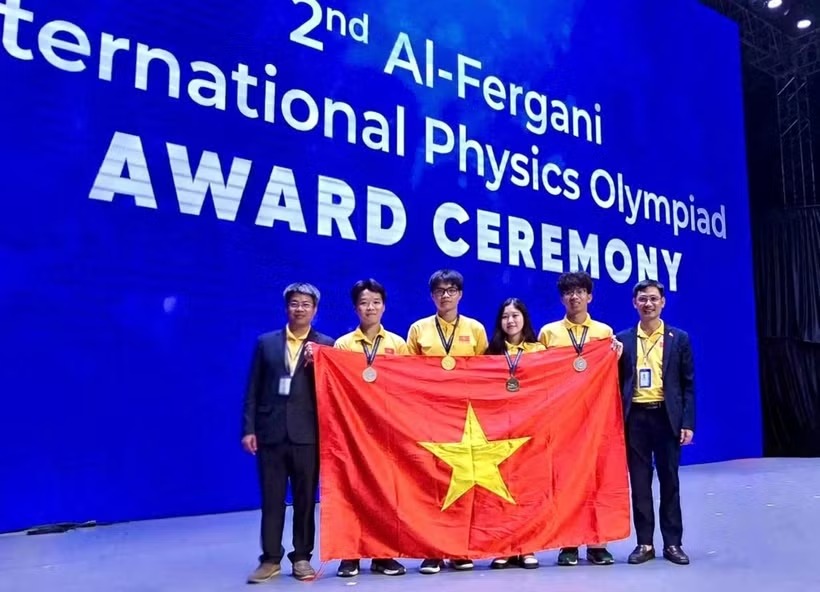
All four Vietnamese students who competed at the second Al-Fergani International Physics Olympiad won medals, according to an announcement by the Ministry of Education and Training. The team secured one gold medal, two silver medals and one bronze medal. The results were reported on October 19 after the competition concluded in Samarkand, Uzbekistan.
The international contest ran from October 10 to 17 and attracted 107 contestants from 15 countries and territories. Vietnam finished fourth in the overall ranking, behind Russia, China and host country Uzbekistan. The result gave the Vietnamese team a strong finish in a competition that tested students’ knowledge of physics and their ability to solve challenging problems.
Physics competitions require more than memorising formulas. Students need to understand scientific ideas, apply them to unfamiliar situations and work carefully through complex questions. Preparing for international contests can involve months of study, practice tests and guidance from teachers and coaches. Students also gain experience by meeting peers from other countries and learning how different education systems approach science.
The result highlights the role of science education in Vietnam’s wider development plans. The country has been seeking to strengthen research, technology and innovation as part of its economic strategy. A strong foundation in science can help students prepare for future work in engineering, digital technology, energy and other technical fields.
International competitions can also encourage schools to identify talented students and give them further opportunities. However, one team’s success does not mean every school has equal access to advanced science teaching. Laboratories, trained teachers, learning materials and financial support can vary between communities. Expanding access to these resources is important if more students are to develop their abilities.
The medals are a positive achievement for the four students and their teachers. They also provide an opportunity to encourage other young people to explore physics and related subjects. Science learning can help students build skills in reasoning, problem-solving and careful analysis, which are useful far beyond competitions.
The team’s performance places Vietnam among the stronger participants in this year’s event. The next challenge will be to maintain students’ interest in science and create pathways from school competitions to university study and research. Continued investment in teaching and learning opportunities can help turn individual achievements into wider progress in science education.
