




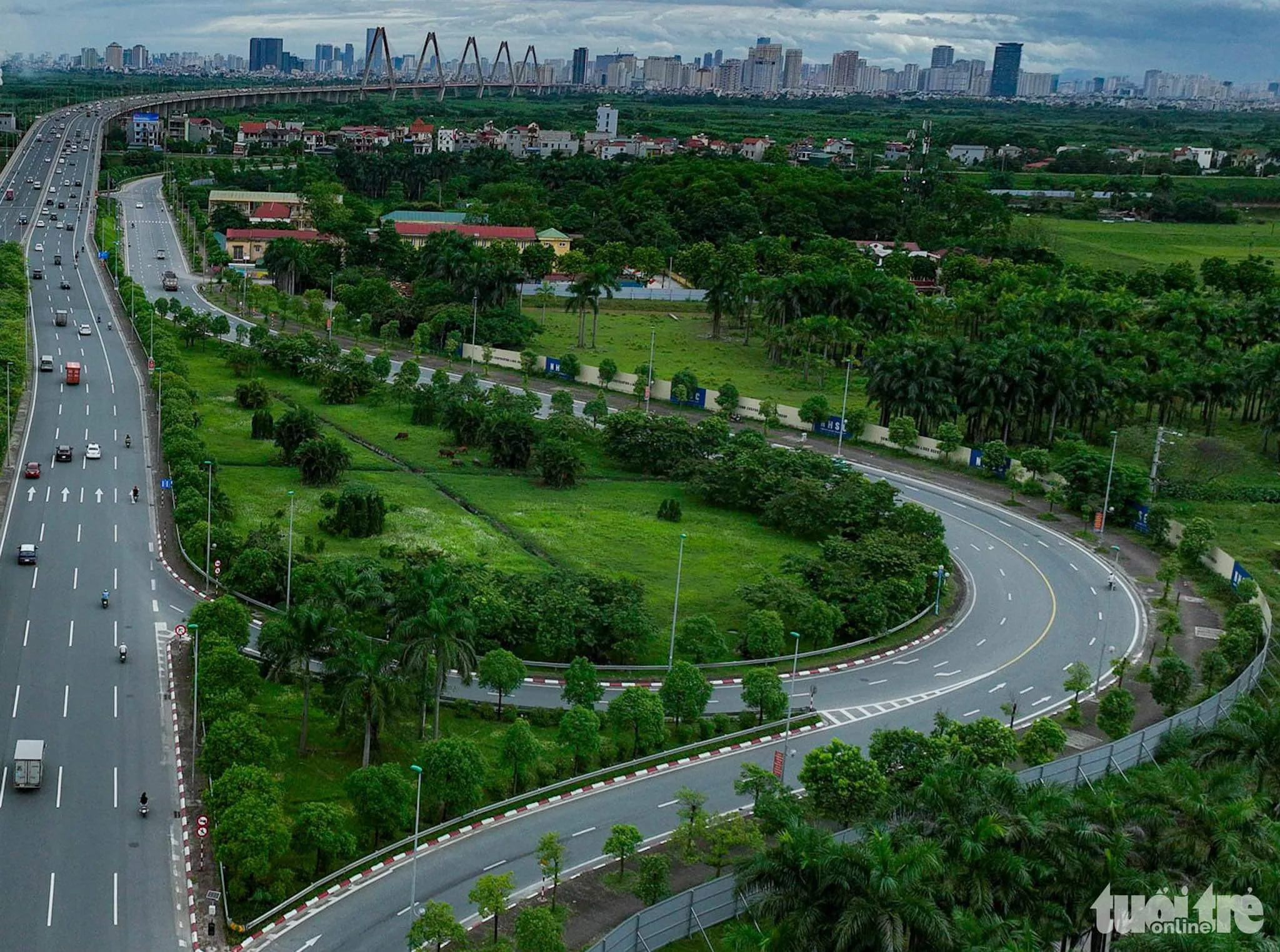
Hanoi has approved a detailed construction plan for the 35.04-kilometre Ta Hong Landscape Boulevard, a major urban transport project expected to improve connections along the Red River. The Hanoi People’s Committee approved the 1/500-scale plan on November 26, establishing the route’s design and the main infrastructure requirements. The project will pass through eight wards and communes and is intended to become an important transport corridor within the capital’s long-term development strategy.
The boulevard will begin at the Hong Ha Bridge interchange in Me Linh commune and continue towards the Hanoi boundary in Bat Trang commune. Its route will pass through several areas, including Yen Lang, Me Linh, Thien Loc, Vinh Thanh, Dong Anh, Bo De, Long Bien and Bat Trang. The main road is planned to have six motor-vehicle lanes, while its maximum width will reach 73.5 metres in some sections. The plan also includes eight interchanges with bridges to improve connections between different parts of the route.
The design will vary according to the surrounding landscape and existing infrastructure. Some sections will include service roads alongside the main carriageway, while other areas will require narrower layouts to reduce the impact on established buildings and heritage sites. Near the Duong River, the planned bridge will be 56 metres wide. The section near Long Bien Bridge will be narrower, with a width of 49.5 metres, partly to limit the effect on religious and historical sites in the area.
The route will also include a semi-tunnel section near Long Bien and Chuong Duong bridges. This section is expected to be around 55.5 metres wide and will carry six main motor-vehicle lanes alongside two mixed-use lanes. In the Bat Trang area, the design will use the existing dyke surface and an inner-foot road as service roads. This approach is intended to reduce the amount of land that must be cleared while maintaining the planned transport capacity.
The boulevard forms part of Hanoi’s wider vision for urban development over the coming decades. Its design is linked to the capital’s master plan and the broader development of the Red River area. Large projects of this kind can improve transport access and support new urban activity, but they also require careful planning to protect communities, heritage sites and the environment. The approval of the detailed plan marks an important administrative step, although further work will be needed before the project can move through construction and become part of Hanoi’s transport network.
