




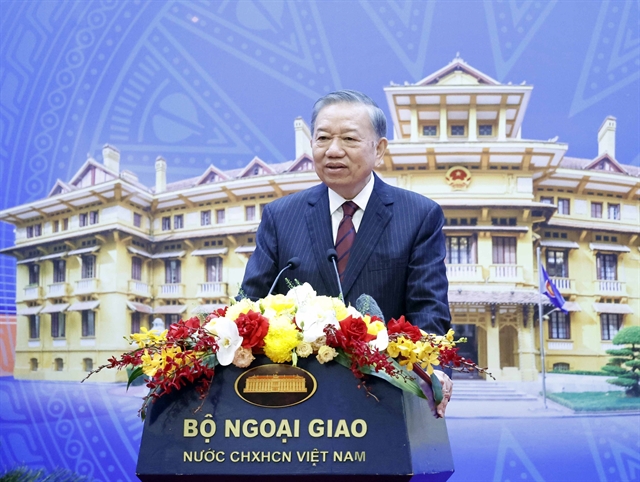
Vietnam’s top leader, Party General Secretary and State President Tô Lâm, has outlined six major priorities for the country’s diplomatic sector as it enters a new stage of development.
Speaking at the opening of the 33rd Diplomatic Conference in Hà Nội on Saturday, Tô Lâm said diplomacy must play a stronger role in protecting national interests, supporting economic growth, and expanding international cooperation.
The conference, held under the theme of strengthening the leading role of foreign affairs in a new era, brings together diplomatic leaders and officials from across the political system. The event will continue until August 7.
Addressing delegates, Tô Lâm said the conference takes place at an important moment for Vietnam. He noted that after more than 80 years of national development and four decades of economic reforms, foreign affairs have been identified as a key and ongoing task for the country’s future.
He said the global environment has changed rapidly since the previous diplomatic conference in 2023. Despite growing uncertainty and complex international developments, Vietnam has continued to achieve significant progress in diplomacy and international integration.
According to Tô Lâm, Vietnam has expanded its network of international partnerships in recent years. The country now maintains Comprehensive Strategic Partnerships with nine nations, Strategic Partnerships with 11 countries, and Comprehensive Partnerships with five others.
Relations with neighboring countries, major powers, ASEAN members, and traditional partners have continued to strengthen. Diplomatic cooperation across different channels has also improved.
The leader highlighted several achievements in multilateral diplomacy. Vietnam successfully hosted major international events, including the ASEAN Future Forum and the P4G Summit. The country also played a role in the signing ceremony of the United Nations Convention on Cybercrime.
Vietnam was recently re-elected to the United Nations Human Rights Council for the 2026–2028 term. The country received the highest number of votes among Asia-Pacific candidates.
Economic diplomacy has also expanded. Vietnam has signed 17 free trade agreements covering more than 60 countries and territories. By 2025, the country’s import and export turnover reached approximately 930 billion US dollars, placing Vietnam among the world’s leading trading economies.
While recognizing these achievements, Tô Lâm also pointed to several challenges facing the diplomatic sector.
He said the issue is often not a lack of policy but the need for stronger implementation. In some cases, research and forecasting efforts have struggled to keep pace with rapidly changing international developments.
The leader noted that some reports focus on describing events rather than analyzing how those developments affect Vietnam and what actions should be taken in response.
He also said that positive political relations have not always produced equivalent economic or technological benefits for businesses and citizens. In some cases, attention has focused more on meetings and agreements than on practical results.
Tô Lâm stressed that diplomacy must remain proactive rather than reactive. He said foreign affairs should anticipate future challenges and help secure resources for national development.
To achieve these goals, he outlined six key priorities for the diplomatic sector.
The first priority is improving research and forecasting capabilities. He called for better analysis of global trends, strategic risks, and emerging technologies. Areas of focus include artificial intelligence, semiconductors, digital transformation, cybersecurity, energy security, finance, and data protection.
The second priority is strengthening the effectiveness of international partnerships. Tô Lâm said agreements should be converted into specific projects and measurable outcomes. He called for clear implementation plans following high-level visits and international agreements.
The third priority is ensuring diplomacy directly supports Vietnam’s long-term economic development goals. He emphasized attracting investment in advanced industries such as semiconductors, biotechnology, clean energy, artificial intelligence, and modern agriculture.
He also stressed the importance of linking foreign investment with technology transfer, workforce development, and participation by Vietnamese companies in global supply chains.
The fourth priority focuses on enhancing multilateral diplomacy. Vietnam aims to continue strengthening its role in organizations and forums such as the United Nations, ASEAN, APEC, and Mekong regional cooperation mechanisms.
The fifth priority is improving coordination and implementation mechanisms within the diplomatic system. He called for stronger cooperation among agencies and faster solutions to administrative and policy obstacles.
The sixth and final priority is building a highly skilled diplomatic workforce. Tô Lâm said the recruitment, training, and evaluation of foreign affairs officials should focus on performance, expertise, and the ability to meet the demands of a changing global environment.
In his closing remarks, the leader expressed confidence in Vietnam’s diplomatic corps and called for immediate action after the conference. He urged agencies to turn discussions into practical plans with clear responsibilities, deadlines, and monitoring systems to ensure results.
He said diplomacy must continue contributing to peace, national security, international cooperation, and the country’s sustainable development in the years ahead.
