




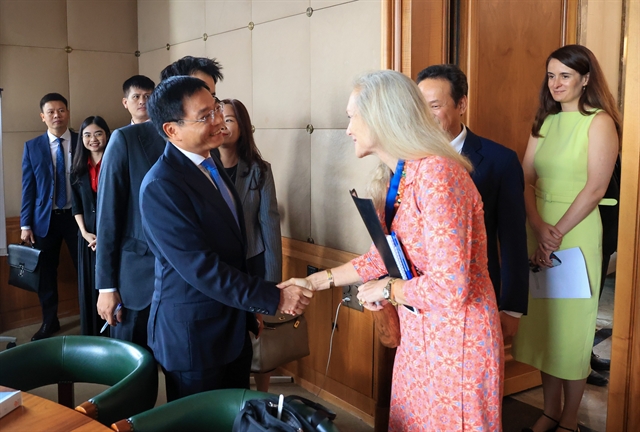
Deputy Prime Minister Nguyễn Văn Thắng has called for stronger support from the World Trade Organization (WTO) and the World Economic Forum (WEF) as Việt Nam works toward its long-term economic development goals. During a working visit to Switzerland on July 27, he met with senior officials from both organizations and outlined the country’s priorities for trade, investment, innovation, and economic growth.
At a meeting with WTO Deputy Director-General Jennifer DJ Nordquist, Thắng reaffirmed Việt Nam’s support for an open, transparent, fair, and rules-based global trading system. He said the WTO remains a key pillar of international trade and plays an important role in supporting stability and cooperation among member economies.
The Deputy Prime Minister highlighted Việt Nam’s active role within the WTO. He noted that the country has contributed to major initiatives, including ratifying the first phase of the Agreement on Fisheries Subsidies. Việt Nam is also negotiating entry into the expanded Information Technology Agreement and preparing for its next Trade Policy Review, which is scheduled for late 2026.
Speaking about current global challenges, Thắng outlined three priorities for the WTO. He said the organization should continue reform efforts by updating trade rules to reflect new developments in international commerce while considering the different levels of development among member countries. He also stressed the need to fully restore the WTO dispute settlement system to improve transparency, predictability, and confidence in global trade. In addition, he called for a broader WTO agenda that includes digital trade, artificial intelligence, climate action, green transition, and supply chain resilience. He said developing countries should receive stronger support to take advantage of new opportunities created by these trends.
Thắng also shared details of Việt Nam’s long-term development strategy. He said the country aims to become a high-income developed nation by 2045 and plans to maintain annual economic growth of at least 10 percent between 2026 and 2030. To achieve this target, the government is focusing on reforms in institutions, infrastructure, science, technology, and investment.
One major initiative is the development of the Việt Nam International Financial Centre. The project will operate under a one-center, two-location model in Ho Chi Minh City and Đà Nẵng. It will be supported by free-trade zones, regulatory testing mechanisms, and business-friendly policies designed to attract investment and support economic growth.
The Deputy Prime Minister said continued WTO support would help Việt Nam strengthen trade policies, improve export performance, attract quality investment, and increase its competitiveness in international markets. He also expressed hope that the organization would continue providing training programs, technical assistance, and legal support related to trade issues.
Nordquist praised Việt Nam for its strong economic progress and efforts to improve its institutional framework and business environment. She highlighted the importance of transparency in policymaking and encouraged the country to keep the WTO informed about legislative and policy changes related to trade and investment. She confirmed that the WTO will continue supporting Việt Nam’s integration efforts and work closely with the country on its upcoming Trade Policy Review. She also encouraged Việt Nam to consider joining the Investment Facilitation for Development Agreement.
Later the same day, Thắng met Andre Hoffmann, Co-Chair of the Board of Trustees of the World Economic Forum. During the meeting, he highlighted Việt Nam’s economic momentum and reform efforts. He noted that the country’s economy expanded by more than 8.2 percent during the first half of the year, reflecting strong growth across multiple sectors.
Thắng said that a large share of the funding needed for Việt Nam’s next stage of development will come from domestic and international businesses and investors. He urged the WEF to continue supporting public-private partnerships and connecting the Vietnamese Government with leading global companies, investors, and financial institutions.
Building on existing cooperation, including the Centre for the Fourth Industrial Revolution in Ho Chi Minh City, Thắng proposed a new Việt Nam–WEF Cooperation Programme for 2026–2030. The initiative would focus on science, technology, innovation, and the development of a modern financial ecosystem.
Hoffmann described Việt Nam as one of the region’s most dynamic economies and praised its potential in digital transformation, innovation, and financial center development. He said the WEF would continue supporting the country by strengthening links with multinational companies, financial institutions, and international business networks. He also expressed confidence that Việt Nam will successfully host the APEC Economic Leaders’ Week in 2027 and said the WEF is ready to help connect the country with investors, experts, and business leaders from around the world.
During his visit, Thắng also met staff at the Vietnamese Embassy in Switzerland and encouraged stronger cooperation with Swiss institutions, investment funds, research organizations, and businesses to expand trade and investment opportunities between the two countries.
