




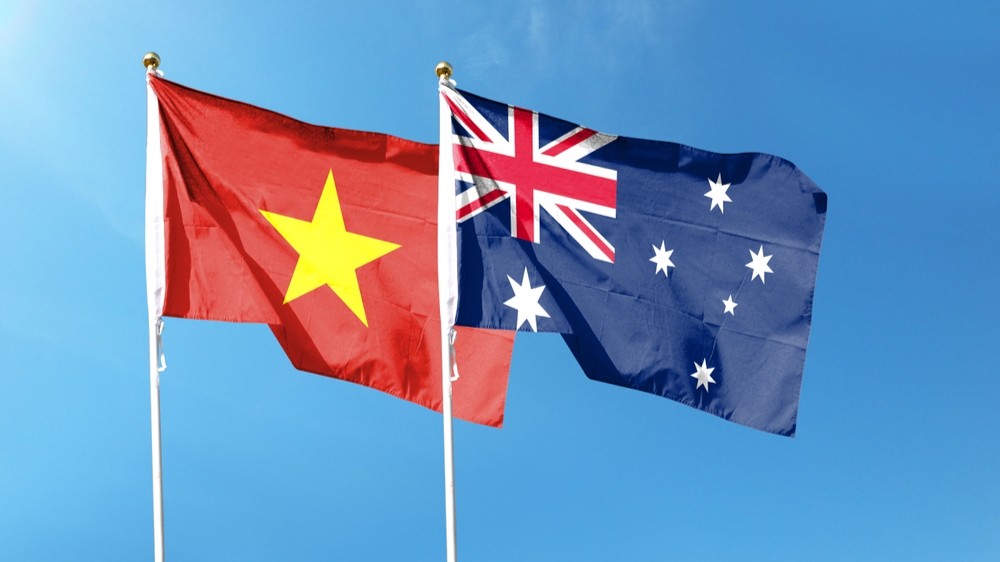
Vietnamese Party General Secretary and President Tô Lâm is visiting Australia from August 9 to 14 as both countries seek to give fresh momentum to their Vietnam Australia strategic partnership.
The visit is being made at the invitation of Australian Governor-General Sam Mostyn. It is the first state visit to Australia by a Vietnamese Party and State leader.
The trip comes as ties between the two countries continue to grow. Vietnam and Australia have built stronger links in trade, investment, education, technology, defence and culture.
The two countries established diplomatic relations on February 26, 1973. Their ties have grown through several key steps over more than five decades.
The relationship became a Comprehensive Partnership in 2009. It was strengthened in 2015 and upgraded to a Strategic Partnership in 2018.
In March 2024, the two sides raised their ties again to a Comprehensive Strategic Partnership. The new framework covers political trust, trade, investment, science, technology, education, climate action, defence and people-to-people links.
An action plan for 2024 to 2027 was signed in October 2024. The two countries completed 96% of the planned tasks within two years, showing strong support for closer cooperation.
Political contact has also increased. More than 20 bilateral cooperation channels are now active. They include meetings between prime ministers, foreign ministers and defence ministers.
The two sides have also agreed to seek $20 billion in two-way trade and double bilateral investment in the coming years.
Trade is already a major part of the relationship. Two-way trade has passed $14 billion. During the first half of 2026, trade rose nearly 22% from a year earlier to $8.1 billion.
Vietnamese exports to Australia increased 25% to $3.8 billion during the same period.
The two economies have different strengths, which gives them room to work together. Both are part of major trade agreements, including the CPTPP, RCEP and AANZFTA.
These agreements can help both countries expand markets and build stronger supply chains.
Australia is also an important source of development aid for Vietnam. It pledged 98.3 million Australian dollars in grants for the 2026-27 financial year.
Australian aid has supported infrastructure, digital change, climate action and green growth. It has also supported training and education in Vietnam.
Technology is becoming another key area. The two countries are working together on artificial intelligence, semiconductors, digital data and critical minerals.
The Vietnam-Australia Strategic Technologies Centre opened in Hanoi in June 2025. It focuses on areas such as 5G, 6G, artificial intelligence and semiconductors.
A new science, technology and innovation programme launched in July 2026 is also supporting research links between universities, research bodies and businesses.
Education remains a strong link between the two countries. Australia offers about 70 scholarships to Vietnamese students each year.
Nearly 25,000 Vietnamese students were studying in Australia in 2026. Vietnam is now the fourth largest source of international students in Australia.
Cultural and local links are also growing. The two countries have 15 active sister-city and local partnerships.
Vietnamese cultural groups have also visited Australia. In early 2026, the Hue Royal Court Music Ensemble toured three Australian states.
Defence and security cooperation has also expanded. Australia has supported Vietnam’s UN peacekeeping work through transport and training for field hospitals and military medical teams.
The two countries held their first ministerial security dialogue in Canberra in October 2024.
Vietnamese officials say the current visit could help set new goals for the next stage of the relationship.
Deputy Foreign Minister Nguyễn Mạnh Cường said Australia has strong expertise in areas that match Vietnam’s development plans. These include science, technology, innovation, digital change, workforce training and modern governance.
Vietnamese Ambassador to Australia Phạm Hùng Tâm said the visit could create progress in digital change, science and technology, and the digital economy.
The two sides are also expected to discuss stronger supply chains, trade, investment, education and health cooperation.
The visit comes during a period of major global and regional change. Vietnam and Australia are expected to discuss shared security and economic concerns and strengthen cooperation in international forums.
Tô Lâm’s visit is therefore more than a diplomatic event. It is a chance for both countries to build on recent progress and set new priorities.
The two governments now face the task of turning their strategic partnership into practical results. Stronger trade, technology, education and security links could give the relationship a wider and deeper base in the years ahead.
