




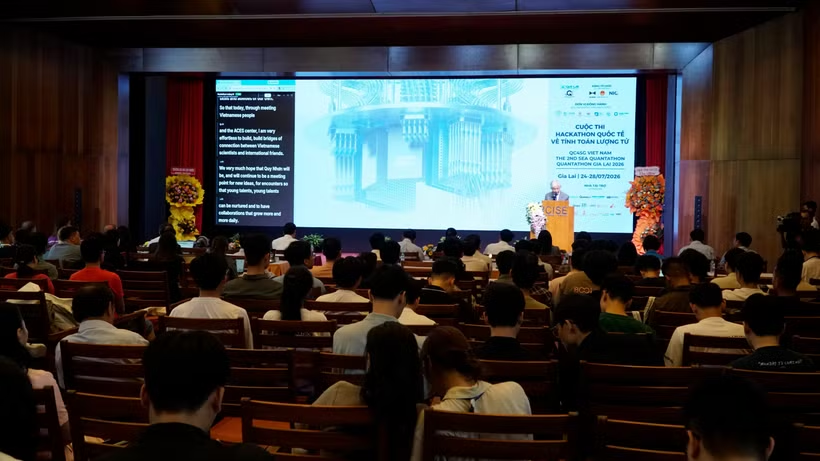
The Vietnam Quantum Computing Symposium opened in Gia Lai Province on Monday, bringing together researchers, educators, and students to explore the basics of quantum computing and semiconducting technologies. The event marks the beginning of the Vietnam Quantum Roadshow, a nationwide program designed to expand knowledge of quantum science and inspire the next generation of technology professionals.
The symposium is organized by Vietnam’s National Quantum Technology Network with support from the Gia Lai Provincial People’s Committee and the National Innovation Center. It aims to introduce quantum computing concepts to students studying mathematics, physics, chemistry, engineering, information technology, and other science-related fields.
The Vietnam Quantum Roadshow will continue in different regions across the country. Organizers hope the program will encourage more young people to study quantum technologies and prepare for future careers in advanced science and engineering.
Several leading academic institutions are supporting the initiative. The Vietnam Institute for Advanced Study in Mathematics provides expertise in mathematical foundations, while the Quantum Technology Institute at Vietnam National University in Hanoi contributes knowledge in quantum physics. The Institute of Astronomy and Space Quantum Communications also supports the program by sharing research on quantum technology applications.
The symposium features presentations from experts representing universities and research organizations in Vietnam and abroad. The sessions cover both theoretical concepts and practical applications of quantum science.
Associate Professor Dr. Đinh Trung Hòa from Troy University in the United States explained the key differences between classical information and quantum information. He said that classical computers store information in clear and separate states, while quantum computers rely on quantum states that behave in very different ways.
Dr. Hòa introduced important concepts such as qubits, superposition, interference, and quantum entanglement. He explained that these properties allow quantum computers to solve certain problems much faster than traditional computers.
He also discussed the no-cloning theorem, which prevents quantum information from being copied in the same way as classical data. According to Dr. Hòa, these unique characteristics could lead to major advances in quantum communication, quantum cryptography, and high-performance computing.
Dr. Vũ Quang Minh from the Posts and Telecommunications Institute of Technology focused on Quantum Key Distribution, commonly known as QKD. He described QKD as one of the most important technologies for secure quantum communication.
Dr. Minh explained that QKD allows two parties to create a shared secret encryption key with security protected by the laws of quantum mechanics. Unlike traditional encryption methods, QKD can detect attempts to intercept information during transmission.
He noted that modern digital services, including online banking, healthcare systems, government services, and business networks, all depend on secure encryption keys. Protecting these keys has become increasingly important as digital communication continues to grow.
Dr. Minh also discussed the future impact of quantum computing on cybersecurity. He explained that today’s encryption systems are extremely difficult for classical computers to break. However, future quantum computers could solve these problems much more quickly by using advanced quantum algorithms.
Because of this possibility, researchers are developing new security methods such as Post-Quantum Cryptography and Quantum Key Distribution to protect future communication networks.
Dr. Vũ Tuấn Hải from the University of Information Technology at Vietnam National University in Ho Chi Minh City introduced students to the differences between classical, probabilistic, and quantum computing.
Using simple examples, he explained concepts such as Turing machines, computational complexity, and quantum walk algorithms. His presentation helped students understand how quantum algorithms process information differently from traditional computer programs.
Dr. Hàn Huy Dũng from Hanoi University of Science and Technology discussed the interdisciplinary skills required to build a quantum computer. He said the field combines physics, chemistry, electronics, materials science, computer programming, and engineering.
According to Dr. Dũng, researchers must understand quantum mechanics, qubit behavior, digital circuits, signal processing, microcontrollers, FPGA technology, and software development to design reliable quantum computing systems.
He also emphasized that building quantum hardware requires continuous testing, error analysis, noise reduction, and system improvement throughout the development process.
The one-day symposium also includes presentations on atomic and molecular structures, light particles, quantum physics experiments, and the use of quantum mechanics in materials research.
Organizers hope the event will strengthen collaboration among universities, researchers, and students while increasing public understanding of quantum science. As quantum technologies continue to advance worldwide, Vietnam is working to develop local expertise and prepare a skilled workforce capable of supporting future innovation in computing, communications, and advanced semiconductor technologies.
